
Back to: Introduction to Circular Economy
In this lesson , we will briefly explore four key economic models. You will gain an understanding of the fundamental concepts behind each model and learn how they differ in their approach to sustainability and resource use.
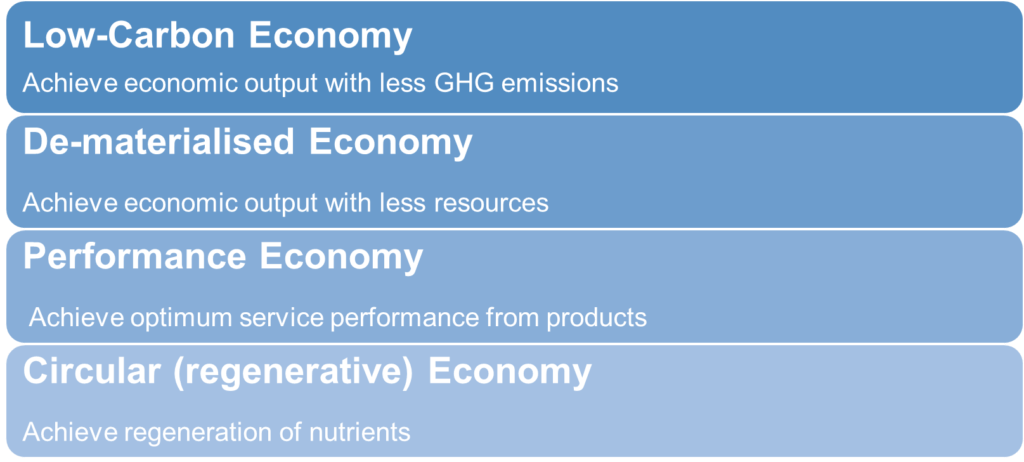
1. Low carbon economy
The goal here is to produce the same economic output with fewer greenhouse gas emissions. Achieving this reduces environmental impact while maintaining economic growth. This aligns directly with the objectives of circular economy, which aims to minimize harmful emissions and waste while keeping resources in circulation.
2. Dematerialized economy
This focuses on using fewer resources to achieve the same level of economic output. It emphasizes circulation and maximizes the value extracted from materials, reducing the need for raw materials. This directly supports CE by promoting resource efficiency and less reliance on finite natural resources.
3. Performance economy
It’s all about getting more out of products, making them last longer, improving how they perform, and building services around them to keep them useful for as long as possible. In the circular economy, this approach is key to maximizing the value of products, ensuring they are reused and repurposed instead of just thrown away.
4. Circular economy
Finally, the circular economy itself ties all these concepts together. CE focuses on designing systems where products, materials, and resources are kept in use for as long as possible. The idea is to regenerate materials and nutrients within economic processes, creating a closed-loop system that reduces waste, conserves resources, and minimizes environmental impact. Circular economy brings together the principles of low carbon, dematerialized, and performance-based approaches to create a sustainable, efficient, and regenerative economic system.
1.3.1 Regeneration in circular economy
The core idea behind circular economy is regeneration. Ensuring that resources, materials, and nutrients are continually cycled back into the system. However, there are other similar concepts that are crucial in supporting and integrating into how CE is practiced. These concepts help create a sustainable and efficient economic model, each contributing to the larger goal of reducing waste and maximizing resource use.