
Back to: Introduction to Circular Economy
In this lesson we’re going to examine how the implementation of circular economy practices outcomes differs depending on the different perspectives. Specifically, we’ll explore the outcomes from three distinct perspectives, providing a comprehensive understanding of its outcomes.
1.Buiness perspective
2.Consumer perspective
3.Policy perspective
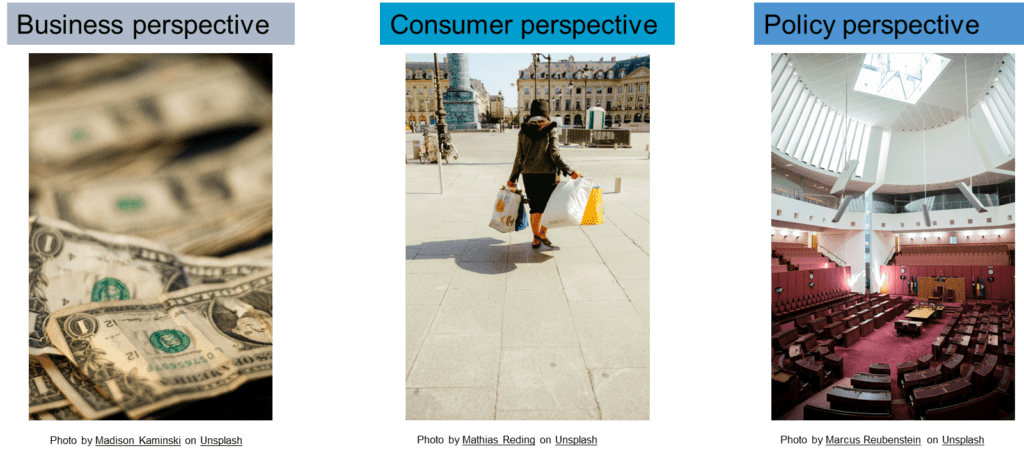
| Linear vs circular thinking – Business perspective |
The following table indicates the major differences between linear and circular economy outcomes from a business perspective.
| Let’s compare | Linear economy | Circular economy |
| Source of value creation? | Product | Functionality and performance |
| Distance between source of production and consumption? | Distant Economies of scale and global production chains have a play | Two are closely linked |
| Product or user needs takes priority? | Steer consumer needs towards product offer | User need/utility drives service Service drives product |
| Focus on the end-of-life phase? | Lack of focus | Is an opportunity for resource mining Focus from the inception |
| Linear vs circular thinking – consumer perspective |
The table below shows the key differences between linear and circular economy outcomes from a consumer perspective.
| Let’s compare | Linear economy | Circular economy |
| Purchase is focused on | Product purchase – Consumerism follows marketing | Utility/service – Fulfilling the need drives the purchase |
| Cost / Differentiation focus | Competitiveness through global value chains used for cost reduction | Local, customised production attitude |
| Buyers’ intent with the purchase | Ownership is the norm | Accessibility is the norm |
| Value at the end of life | Low/no residual value of products Designed to degenerate | Value at end of life Designed to regenerate |
| Linear vs circular thinking – policy perspective |
The main differences between the outcomes of the linear and circular economies in policy perspective are shown in the following table.
| Let’s compare | Linear economy | Circular economy |
| Risks on the economy | Growth focus with taking resources as infinite | Addresses resource security and decouples growth /resource barrier |
| Value to the economy comes from | Dependence on the existing production system | Facilitating skilled workforce for services |
| Focus on locality | Global playing field – competitiveness through globalisation | Local focus, Co-dependent communities co- creating value |
| Regulatory focus for products | Balance consumer protection with economic stakes | Safe and healthy services |
| Cost of end-of-life management of resources | Waste management is cost for the government | End-of-life management is a way of regenerating resources for the economy |
As discussed in this lesson, the differences between linear and circular economic models have been explored in depth, helping you gain a clear understanding from three key perspectives.